Questions
Day 1
Scriptural Reflection
1 Kings 9:10–28
This week we shall continue the
study of the book of 1 Kings in the Old Testament.
After the description of how Solomon finished his most important projects, the building of the Lord’s temple and the palace complex, the Bible gives us a glimpse into the other military and commercial activities of Solomon:
9:10-19—Fortification of Cities in the Outskirt
(1) How long was Solomon’s reign? (1 Ki. 11:42) What might be the significance that he spent most of his energy during the first half of his reign in these two building projects?
(2) From the account of 2 Chronicles 8:1-2, it appears that Hiram returned these twenty Galilean cities to Solomon who then rebuilt them. What was the reputation of Galilee which lasted from the above event not only to the time of the writing of the Books of the Kings, but all the way to Jesus’ time? (Kabul or Cabul, presumably means “good for nothing”; see also Jn. 7:3, 41, 52.)
(3) The towns fortified by Solomon (in vv. 15-17) were basically cities in the outskirts from Hazor (in the far north), Megiddo (in the northwest coast), Gezer, Lower Beth Horon and Baalath (along the southwest coast) and Tadmor (in the extreme south, near Edom). According to 2 Chronicles 8:4-6, they were reinforced for defense purposes, stationed with chariots and horses: What picture is being painted by this account?
(4) In these projects of re-fortification only non-Israelites were used as forced labor. What was the importance of this emphasis? (see Deut. 20:11; Lev. 25:39)
(5) What was the reason for moving his wife, the daughter of Pharaoh, away from the City of David into her own palace? (see 2 Chr. 8:11) Do you admire Solomon’s intention? Why or why not?
(6) We were introduced to Solomon in the beginning as someone who loved the Lord, “except that he offered sacrifices and burned incense on the high places” (1 Ki. 3:3). What then did Solomon do that amounted to the “fulfillment of his obligation” upon the completion of the temple (see 9:25)?
(7) In concluding the account of the various projects of Solomon, what does the account of vv. 26-28 serve to reflect? (you may wish to consult the Note below)
(8) What is the main message to you today and how may you apply it to your life?
Note:
While Israel had never been known for its naval superiority, in the time of Solomon, he was able to take advantage of his alliance with Hiram to build a respectable fleet, achieving stability in land (with the fortified cities) and sea (with the fleet). This too, reflected the wisdom of Solomon over his predecessors and successors. The mining of gold from Ophir (the location of which is uncertain to these days) also reflected his wealth, as 16 tons of gold was quite substantial in value!
Day 2
Scriptural Reflection
1 Kings 10:1–13
(1) How did the Queen of Sheba (see Note below) know of Solomon’s “relationship to the Lord”? (v. 1)
(2) Do people know of “your relationship to the Lord”? Why or why not?
(3) Why did she come to ask “hard questions”? (v. 1)
a. To prove Solomon wrong?
b. To learn from him?
(4) Do people come to ask you “hard questions” about your faith? What might be their intention?
(5) What were the things that had caused the queen to be “overwhelmed”? (v. 5)
(6) If you were the queen of Sheba, would you have responded in the same way? Why?
(7) The queen mentioned about Solomon’s achievements, wisdom and wealth (vv. 6-7).
a. What is “wisdom” as defined by the Bible? (Prov. 9:10)
b. Among the three things mentioned by the queen, what might be the most important to a person?
c. Are wealth and achievement a must for a person to accomplish the following?
- To bring glory to God in his or her life; to prove that he or she is pleasing to the Lord; or to change the society. Why or why not?
d. The queen's conclusions about Solomon's kingdom:
- What was the cause of the happiness to Solomon’s people and officials? (v. 8)
- What was the source of Solomon’s success and purpose? (v. 9)
(8) What does this passage about Queen of Sheba serve to illustrate?
(9) What is the main message to you today and how may you apply it to your life?
Note:
While Josephus opines that Sheba is Ethiopia, many scholars think that it refers to Sabeans, an Arabian tribe living in North Arabia.
Day 3
Scriptural Reflection
1 Kings 10:14–29
This passage gives us a picture of the splendor of Solomon:
(1) Gold was obviously the most precious metal and this passage highlights the extravagant use of gold by Solomon:
a. His annual revenue in terms of gold was about 25 tons: How much might it be in today’s value? (1 ton is 2,240 lbs)
b. How many ornamental shields, big and small did he have? (likely used for a parade or special occasion)
c. What else were made of gold in his royal household?
d. Was his wealth necessarily a reflection of God’s glory?
(2) The awesomeness of Solomon’s power was reflected by the following:
a. His one-of-a-kind throne:
- What was it made of?
- What might the two lions on the armrests and the twelve lions on the steps stand for?
b. His military power:
- How many chariots and horses did he have? (a repetition of 4:26)
- Where were they imported from?
c. How does this passage reflect the dominance of Solomon over the region?
(3) The wisdom of Solomon:
a. What was the evidence of Solomon’s wisdom? (vv. 23-24)
b. How might Solomon use such opportunities to bring glory to God?
(4) The splendor of Solomon in terms of wealth, power and wisdom:
a. What might great wealth do to a person?
b. What might immense power do to a person?
c. What might the possession of great wisdom do to a person?
d. In your opinion, which of the three above presented the greatest temptation to Solomon?
(5) What is the main message to you today and how may you apply it to your life?
Day 4
Scriptural Reflection
1 Kings 11:1–13
(1) Why does the Bible make a distinction between the taking of Egyptians and the taking of Canaanites as wives? (See Deut. 7:1-3; Exod. 34:16)
(2) Does it mean then it would have been okay, for Solomon to take as many wives as he could, as long as they were not Canaanite women? (Deut. 17:17; Mal. 2:14-15)
(3) In expressing God’s disappointment with Solomon, how does the Bible highlight how special God had treated Solomon in the past? (v. 9)
(4) What do you think was the main reason for Solomon’s downfall?
(5) Did Solomon only permit his wives and concubines to worship idols or did he participate in idol-worship too?
(6) What examples does the Bible give concerning his idol-worship? (11:5-8)
(7) For someone who once followed the Lord as a leader, to whom God had appeared twice and who had received amazing promises from God, how could he still turn to idols?
(8) Was his downfall sudden or gradual? (See Hos. 4:11, concerning how one can lose one’s understanding or wisdom.)
(9) Does the Bible lay any blame on his father, David? (11:4, 6)
(10) Without reading the consequences of his sin in the Bible, what would you have expected the Lord to do to Solomon?
(11) What punishments did he receive for his sins?
(12) Why didn’t God punish him in his lifetime?
(13) From this, can you see how pleasing David must have been to the Lord?
(14) What is the main message to you today and how may you apply it to your life?
Day 5
Scriptural Reflection
1 Kings 11:14–40
As much as the Lord promised to delay the tearing apart of Solomon’s kingdom in his lifetime, he would have to face immediate punishment, though to a lesser degree than might be expected:
11:14-25—External Threats
(1) The first threat mentioned here was from Edom:
a. What extra effort was put in by Joab to ensure the complete extinction of the Edomites (likely meaning all the household of the royal family)? (See 1 Chr. 18:12-13 as well.)
b. Based on what happened now, do you think Hadad’s escape was accidental? (11:14)
c. With Pharaoh giving a daughter to Solomon and now giving the sister of his own wife to Hadad, what kind of game did Pharaoh play?
(2) The threat from Aram:
a. Read the complete victory of David over the king of Aram (or Damascus) in 2 Samuel 8:3-8. While king Hadadezer was completely defeated, what does this passage tell us about the opportunistic rise of Rezon?
b. With the rebuke and warning by the Lord and the rise of these opposing powers, what should Solomon have done?
11:25-40—Internal Strife
(3) Do you think Jeroboam had the intention to rebel against Solomon?
(4) In
appointing Jeroboam to rule over the ten tribes of Israel, what did the Lord
tell Jeroboam through the prophet Ahijah in the following areas?
a. The reason for the splitting of the kingdom (v. 33)
b. The reason for retaining one tribe for the descendants of David (vv. 32, 36, see also the Note below)
c. The reason for not splitting the kingdom during Solomon’s lifetime (v. 34)
d. God’s promise to Jeroboam (vv. 37-38)
e. The conditions that God imposed on his rule (v. 38)
f. The temporariness of this punishment of the house of David (v. 39)
(5) If you were Jeroboam, what would you do given the following?
a. You have the heart of Moses (Exod. 32:10ff and Num. 14:12ff)
b. You know that your rise to power was a result of the sin of Solomon
(6) What is the main message to you today and how may you apply it to your life?
Note:
Instead of the promise of one tribe, 12:21 tells us that there were in fact two tribes that remained loyal to the house of David, namely Judah and Benjamin.
Day 6
Scriptural Reflection
1 Kings 11:41–12:15
11:41-43—Death of Solomon
(1) In viewing Solomon’s life and his reign as it came to an end, consider these questions:
a. What do you remember most about him? Why?
b. Try to write a short eulogy of his life.
c. What one word might you use to sum up his life?
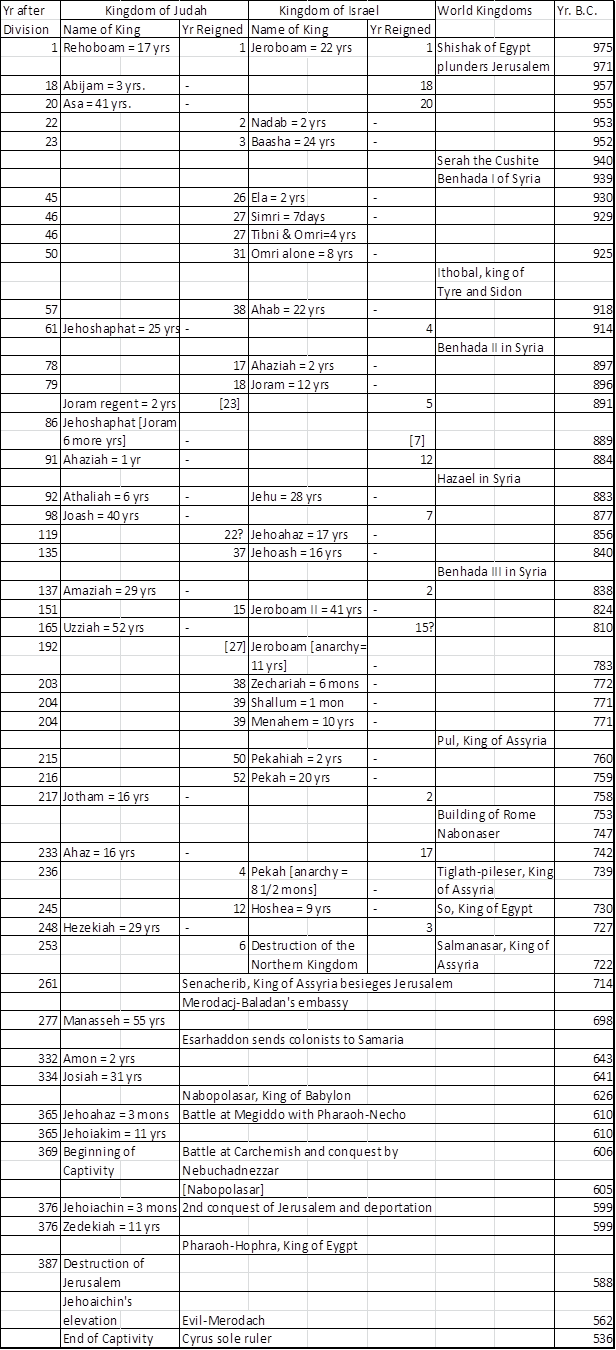
The Divided
Kingdoms: Please refer to the following
chart compiled by Keil and Delitzsch which lists side by side the kings of the
Southern Kingdom (Judah and Benjamin) and the Northern Kingdom (the other ten
tribes) together with significant world events in the region.
12:1-15—The Folly of Rehoboam
(2) What reason was given for why Rehoboam had to go to Shechem of Ephraim to seek to be crowned king, succeeding his father Solomon as the king of Israel? (12:1)
(3) Shouldn’t the people come to Jerusalem to crown him king? How does this reflect the political undercurrent upon the death of Solomon?
(4) Why did the ten tribes send for the fugitive Jeroboam to join them in this important event? (Note that Jeroboam was an Ephraimite.)
(5) What was the request (which was really a condition) made by the people before they were willing to crown Rehoboam king? (12:4) Do you think this was a genuine request or an excuse to rebel against the house of David that they had already resolved to do? (Consider 9:20-22 and the exceeding richness of the country which was more than likely shared by the people.)
(6) While David left many words to Solomon (2:1-9), we do not read about any counsel given to Rehoboam by Solomon before his death. This left him totally unprepared for the challenge of leading the people.
a. What was the essence of the advice given by the elders? (12:7)
b. What was the essence of the advice given by his peers? (12:10-11)
c. Was the difference between the two groups necessarily one of age? Why or why not?
d. Why did Rehoboam choose the advice of the younger ones?
(7) This was the pivotal moment in the history of the united kingdom: Should the blame be laid on Solomon, Rehoboam or the ten tribes? Or was it simply a must “to fulfill the word of the Lord”? (12:15) Why?
(8) What is the main message to you today and how may you apply it to your life?
Day 7
Scriptural Reflection
1 Kings 12:16–33
(1) By their words of rejection in v. 16, what was the real motive of their rebellion?
(2) Ultimately, against whom were they rebelling?
(3) Why then did the people of Judah remain loyal to Rehoboam? Had they not borne the same “heavy yoke”? (12:4)
(4) At his escape from the hands of the rebels, what did Rehoboam plan to do?
(5) How many fighting men did he muster? Does this explain to you why he seemed not to be afraid of the rebellion of the ten tribes?
(6) How was this potential bloodshed avoided?
(7) However, as Rehoboam and his people “obeyed the word of the Lord” (12:24), it had given Jeroboam the opportunities of both fortifying his cities and devising the most evil scheme that plunged Israel into sin:
a. What scheme did Jeroboam devise? (12:28)
b. What was his motive? (12:26-27)
c. How did he “sell” this to the people? (12:28-29)
d. How evil was his action? (see Exod. 20:4; Deut. 12:5ff)
(8) How cunning was his scheme in appointing “priests from all sorts of people, even though they were not Levites” (12:31)?
(9) Jeroboam appeared to have substituted his own festival in the 8th month to replace the great Festival of Tabernacle mandated to be celebrated by the Lord in 7th month, thereby ensuring that there was no need for the people to go to Jerusalem to worship the Lord. Of all the sins committed by any king of Israel (or for that matter, any individual), these sins of Jeroboam were mentioned at least 25 times in the Bible (1 Ki. 13:34, 16:2, 19, 26, 31 and 2 Ki.13:2, 6, 11; 23:15, to name but a few places):
a. Why were such sins so heinous in the eyes of the Lord?
b. Can you think of any sins that could parallel these in the history of Christianity, including today?
(10) What is the main message to you today and how may you apply it to your life?